

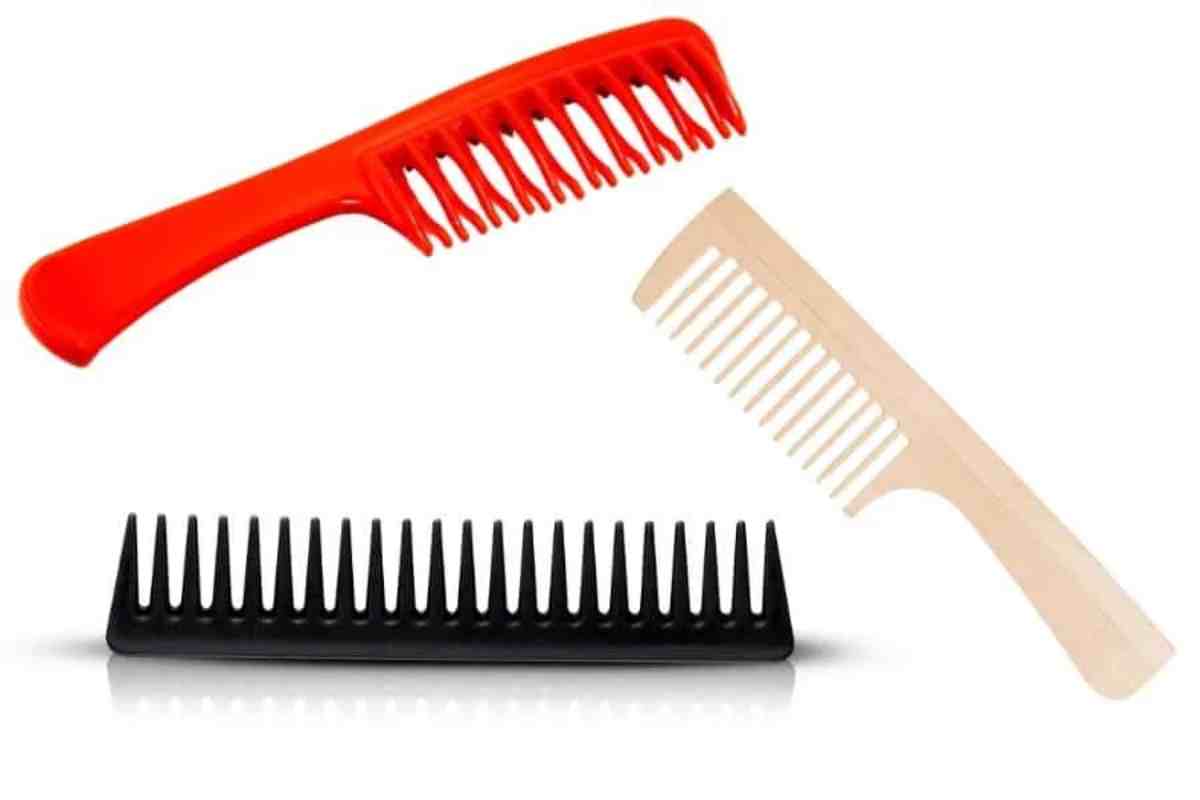
Wide Tooth Comb for Curly Hair – A wide-tooth comb is a comb with teeth that are spaced further apart than in normal combs. The spacing of teeth gives the ability of a comb to pass through the hair with less resistance, thus less pulling, breaking, and damage to the hair shafts. And on curly hair, which will tend to twist and tangle itself, this distance makes a difference.
Table of Contents
Why curly hair and wide-tooth combs are a perfect match
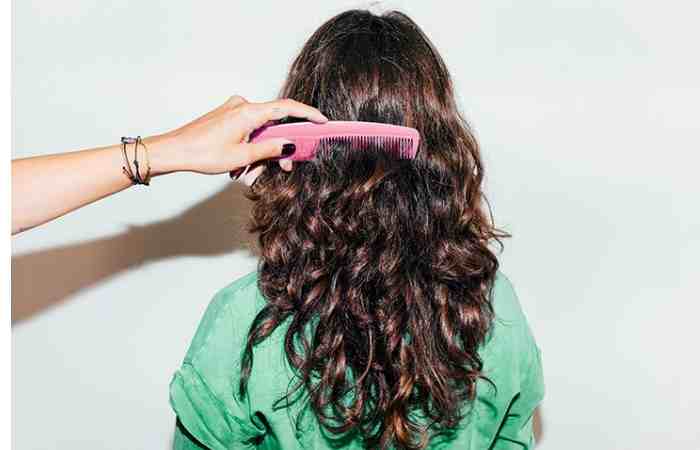
Strands of curly hair are apt to raise and twist off the head. Such a structure leaves them weaker where the spiral diverges and crosses over. Your donks snatch and tear as you rudely brush out or pull out at the roots. There are wide-tooth combs, which go through groups of curls without tearing them open.
Imagine it is like tangling a rope of beads, as opposed to a knot of yarn. A wide-toothed comb is a sort of fingers with care, which part the beads. A fine-tooth comb is a fork — good in some applications but dangerous with knotted and delicate fibers.
Wide-tooth comb vs other detangling tools
| Tool | Best for | Pros | Cons |
| Wide-tooth comb | All curly types (2A–4C), wet or conditioned hair | Gentle, reduces breakage, great for distributing product, inexpensive | Can’t smooth fine frizz or create sleek parting like a paddle brush |
| Paddle brush | Straight to wavy hair, blow-drying | Smooths and straightens quickly | Too harsh for tight curls — causes frizz and breakage |
| Denman brush | Defining ringlets (looser curls), styling | Great for clump definition, distributes product | Can be too aggressive for fragile, tight coils if used dry |
| Fingers (manual detangling) | Sensitive scalps, coily types | Most gentle, best for preserving curl pattern | Time-consuming for thick, long hair |
| Wide-tooth comb with handle | Thick or long curls | Better control and leverage | Slightly bulkier, same limitations as wide-tooth comb |
Who should use a wide-tooth comb?
- People with wavy to coily hair (curl types 2–4).
- Anyone who detangles when their hair is wet and conditioned.
- Those who prefer minimal breakage and want to keep curl clumps intact.
- DIYers who want a low-cost, durable tool for daily routine.
Comparison: Popular wide-tooth comb styles
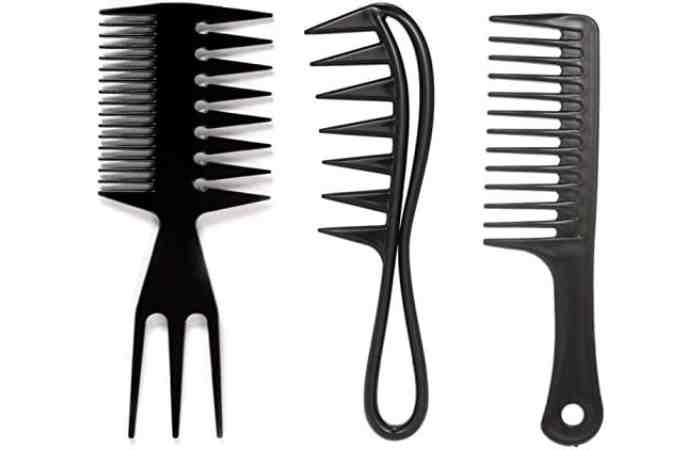
| Style | Best features | When to pick it |
| Pocket wide-tooth comb | Portable, affordable | For touch-ups and short hair |
| Long, handled wide-tooth comb | Good grip, leverage | Thick or very long hair |
| Curved/ergonomic wide-tooth comb | Follows scalp shape | Comfortable detangling sessions |
| Extra-wide spacing comb | Minimizes frizz and stretching | Very tight coils (4A–4C) |
What is the purpose of disentangling?
- In addition to removing knots, disentangling also allows you to dust/ventilate the hair, eliminate dead hair, energize it, and distribute sebum, its protective oil, over the entire length.
- It can also oxygenate the scalp by stimulating its blood circulation.
- Choosing the right “tool” is the first condition for successful detangling without damaging your hair.
- Unlike straight hair, I do not recommend the brush (but it may still be suitable for simply wavy hair).
- To get rid of tangling, it is best to use your fingers only on wet hair (see the detangling instructions for use).
- The fingers indeed have the ideal texture.
- In the book “Curly Girl,” Lorraine Massey also recommends using only her fingers to comb her hair because brushes and combs alter the formation of curls, cause breakage, and can create frizz, according to her. https://hairlust.com/blogs/blog/brushes-and-combs-for-curly-hair
How to choose a wide-tooth comb to disentangle your curly hair?
1. Material of the comb
- Wide Tooth Combs for Curly Hair – The best comb for curly hair (and for all hair types in general) would be the horn comb. Its advantages:
- More reliable, it does not trap electrical charges like plastic (which attracts electrons with negative charges) and thus helps to rebalance the electrical charges of the hair.
- This balance between negative and positive charges is essential for good hair maintenance.
- The complementary hair repels each other (messy look). We search the air for the electrons they lack.
- Also, the horn constitutes keratin, the natural constituent of our hair.
- It is, therefore, the same molecular composition.
- This natural material is more respectful of the environment, which does not spoil anything!
- His advantages? It is antistatic and more robust than its plastic cousin. The horn comb does not pull out the hair.
2. Eco-friendly wooden comb vs horn comb comparison
- The horn comb glides better through the hair (the wooden comb “grips” more).
- The horn comb does not produce static electricity, which is not the case with all wooden combs. Only the horn comb is anti-allergic.
- Choose the material of your detangling comb for curly, frizzy, or frizzy hair.
- Keratin is fragile: it is necessary to favour a material in affinity with its composition so as not to attack it.
- In addition to the static electricity they generate, plastic and metal do not spread sebum (which makes up the hydro-lipid film protecting the hair and ensures its shine and cohesion) and can irritate the scalp.
3. Shape and size of the detangling combs for curly or frizzy hair
- The profession has evolved from year to year to create a real corporation of “Master Comb finally.”
- Alternatives to the horn comb: silicone, carbon, wood (especially oiled beech), or even ionic combs.
- Ebonite and resin are also recommended and used by professionals for their strength.
Types of Wide Tooth Combs for Curly Hair
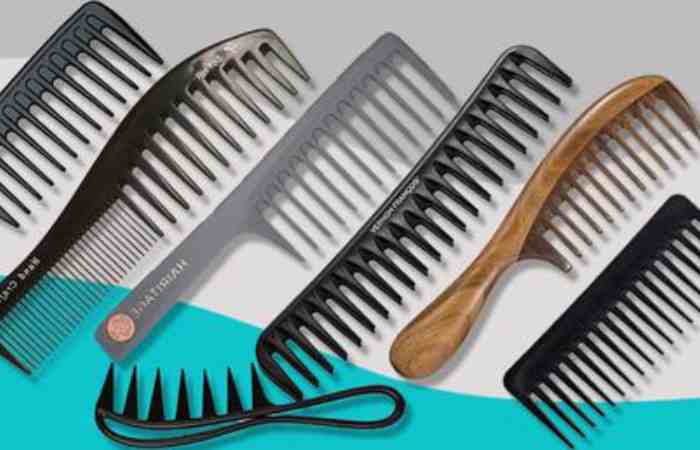
There are different types of wide-tooth combs for curly hair and its uses:
1. Fork Comb
- The fork comb gives volume and texture to the hair.
- Its forks allow to ventilate short curly or very frizzy hair, refresh the hairstyle between two shampoos, and take off the roots.
2. Horn Comb
- The horn comb smooths the hair, closes its scales.
- A comb or a plastic brush would attack them, tear off micro-particles, and further wear down the cuticle.
- The leaves are closed. They wear less quickly, are shiny, and the hair is silky.
3. Detangling Curved Teeth Comb
- The detangling comb is a comb with curved teeth that intersect.
- It is healthy and flexible teeth to detangle hair in depth and style without leaving marks. Each comb has two sizes of teeth.
4. The tail comb
- The tail comb is a comb that ends with a fine tip.
- It allows to draw lines with precision and to separate curly hair gently.
- It is beneficial for dividing the hair into sections to achieve certain hairstyles, such as French braids or installing curlers or specific product.
5. Combs with handles or straight rakes
- They have the same function as the detangler; their teeth are more or less complete and spaced.
- The smaller the spacing between the teeth, the more the comb will catch tiny knots.
- However, a comb with wider teeth avoids too much attack on the hair fibre and limits breakage.
- It is particularly appropriate for curly or frizzy hair because it protects the curls’ shape and the fragility of their cuticles.
6. Round brush made of pure boar bristle
-
- A small round brush with soft bristles is also viral and very popular with long, thick hair or frizzy hair with intense tangles: it is the famous “tangle.”
- This brush’s advantage is that its pins bend before the hair breaks (therefore, limits breakage when untangling knots), so they will “soften the knot” gradually as they pass until they overcome it.
- The other advantage of the tangle lies in its short spikes, which prevent them from sticking into the bit’s entire depth and once again facilitate their bending when they meet a knot.
- The brushes mounted on a floating soft rubber base with movable pins are also recommended for curly hair because they prevent the latter from getting caught in it.
- The brushes equipped with an air cushion make it possible to absorb the meeting’s impacts and limit the weakening of the hair fibre.
Curly Routine — practical, type-friendly schedules
Below are routines you can pick from depending on how much time you have and your curl type. Keep the rule in mind: gentle, wet/conditioned detangling + sectioning = less breakage.
Daily / morning (5–15 minutes)
-
-
- Lightly mist hair with water or a leave-in spray (DIY detangling mix or store-bought).
- Apply a small amount of leave-in or curl cream to damp areas (focus mid-length → ends).
- Use your fingers to gently separate problem tangles; if needed, use a wide-tooth comb from ends → mid-lengths → roots in small subsections.
- Scrunch to reactivate curls and, if required, diffuse on low for 2–5 minutes to set.
- Quick tip: For 3–4 strands only, finger-twisting gives more definition than combing.
-
Pre-shampoo (Pre-poo) — 10–20 minutes
-
-
- Apply a lightweight oil or conditioner to dry hair (coconut, olive, or a commercial pre-poo).
- Leave 10–20 minutes (or overnight) to reduce tangles and protect ends during wash.
- Finger-detangle before getting wet; follow with the wide-tooth comb once conditioner is added.
-
Wash day routine (30–60 minutes depending on hair)
-
-
- Section hair into 4–6 parts (more for thicker hair).
- Apply shampoo only to the scalp; gently massage. Let the water rinse the product and move the knots to the ends.
- Apply a generous conditioner or mask (slip = key).
- Finger-detangle each section first to remove large knots.
- Use a wide-tooth comb, starting at the ends and working upward, until hair is smooth.
- Rinse (or leave-in if you’re doing a leave-in treatment).
- Apply styling products in sections (leave-in → cream → gel). Use the comb to distribute—but sparingly.
- Dry gently: microfibre towel/t-shirt scrunch, then air-dry or use a low-heat diffuser.
-
Deep conditioning (weekly → fortnightly)
-
-
- Use a mask with high slip or a protein + moisture balance mask depending on your hair’s needs.
- Section hair, apply mask generously to mid-lengths and ends, and detangle with fingers first.
- Leave for the recommended time under a plastic cap (15–45 minutes). Gentle heat (steam) helps penetration.
- Rinse and follow your regular styling steps.
-
Protective styling & maintenance (ongoing)
-
-
- Low-manipulation styles: braids, twists, buns, or bantu knots protect ends and reduce tangling.
- Refresh every 3–7 days, depending on frizz & buildup.
- Avoid overly tight styles that put tension on the hairline.
-
Night routine (2–5 minutes)
-
-
- Pineapple (loose high bun) using a satin scrunchie or wrap hair in a satin bonnet/scarf.
- Sleep on a satin pillowcase if you prefer not to wear a bonnet.
- In the morning, use a spritz and fingers or a wide-tooth comb (ends first) to revive curls.
-
Combing Mistakes — what they do to your curls
Below is a targeted table listing common combing mistakes, why each is harmful, immediate fixes if you’ve already done it, and how to prevent it next time.
| Mistake | Why it’s harmful | Quick fix (if done) | Prevention |
| Combing dry tight curls | Friction + breakage → frizz, split ends | Rehydrate with water/leave-in, apply slip (oil/cond.), then detangle from ends. Trim if breakage is severe. | Always detangle wet/conditioned or finger-detangle dry only for loose waves. |
| Starting detangling at the roots | Pulls knots tighter, painful tugging, more snapping | Re-do detangling: dampen, apply conditioner, start from ends in sections. | Always start at the tips and work upward in small sections. |
| Using a fine-tooth comb or paddle brush on coils | Teeth force curls apart, breakage and loss of clump pattern | Switch to wide-tooth comb or fingers; deep condition to restore elasticity. | Use the right tool for your curl type—wide-tooth comb or fingers for coils. |
| Rushing / yanking through knots | Micro-tears in the cuticle, split ends accumulate | Stop, apply a detangling spray or conditioner, work small subsections, use fingers first. | Detangle slowly and in sections; set aside time on wash day. |
Final Words
A wide-tooth comb is forgiving, but it isn’t magic. The biggest hair transformations happen when combing is combined with good products, gentle technique, and consistent care. Expect steps, not miracles — and celebrate the small wins: fewer broken hairs on the floor, clumps that hold their shape, and a smoother wash day.